


The Forgotten Language of Nature: What Shamanism Teaches Us About Listening Beyond Words

Updated: Aug 8

In a world filled with constant notifications, endless conversations, and information overload, silence has become rare. Yet, some of the deepest wisdom cannot be spoken—it can only be experienced. Shamanism invites us to rediscover a way of listening that goes beyond words, helping us reconnect with nature, ourselves, and the rhythms of life.
Across cultures and centuries, shamans have viewed nature as a living source of wisdom rather than a collection of resources. Every tree, river, mountain, and animal carries its own presence and teaches lessons to those willing to observe with openness.
Why Modern Life Has Made Us Forget How to Listen
Many people spend most of their day surrounded by screens, artificial lighting, and busy schedules. Over time, this constant stimulation can create a feeling of disconnection—not only from nature but also from our own intuition.
We often look for answers outside ourselves:
● More advice
● More information
● More productivity
● More distractions
Yet despite having access to endless knowledge, many people still feel uncertain, overwhelmed, or emotionally exhausted.
Shamanic traditions suggest that clarity often emerges not from adding more noise but from creating space for stillness.
Nature Speaks in Symbols, Not Sentences

Unlike human communication, nature rarely speaks through language. Instead, it communicates through patterns, cycles, sensations, and symbolism.
A sunrise reminds us that every ending is followed by a new beginning.
Flowing water demonstrates adaptability and resilience.
A forest teaches patience, interconnectedness, and growth that cannot be rushed.
Whether or not one interprets these experiences spiritually, spending mindful time in nature often encourages reflection and emotional awareness.
The Practice of Deep Observation
One of the most valuable lessons inspired by shamanic traditions is the art of observation.
Instead of immediately analyzing or judging an experience, practitioners often begin by simply noticing.
Ask yourself:
● What emotions arise when I spend time outdoors?
● Which natural places make me feel most peaceful?
● What patterns keep appearing in my life?
● What changes am I resisting?
These questions shift attention from external noise toward inner awareness.
The Wisdom of Natural Cycles
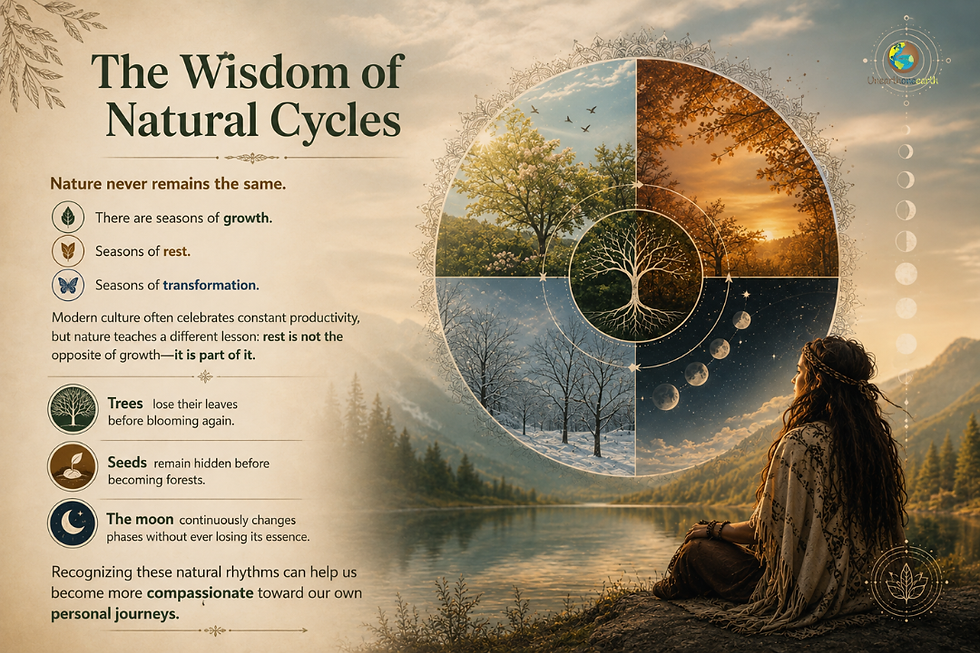
Nature never remains the same.
There are seasons of growth.
Seasons of rest.
Seasons of transformation.
Modern culture often celebrates constant productivity, but nature teaches a different lesson: rest is not the opposite of growth—it is part of it.
Trees lose their leaves before blooming again.
Seeds remain hidden before becoming forests.
The moon continuously changes phases without ever losing its essence.
Recognizing these natural rhythms can help us become more compassionate toward our own personal journeys.
Everyday Ways to Reconnect with Nature
Exploring shamanic-inspired mindfulness doesn't require elaborate rituals. Small daily practices can deepen your connection with the natural world.
You might try:
● Walking outdoors without headphones for 15 minutes.
● Watching the sunrise or sunset without using your phone.
● Sitting quietly beneath a tree and observing your surroundings.
● Journaling after spending time in nature.
● Practicing gratitude for the elements that support everyday life—air, water, sunlight, and earth.
These simple moments encourage presence and cultivate a deeper appreciation for the world around us.
Listening to Yourself Through Nature

Many people discover that when external distractions become quieter, inner wisdom becomes easier to hear.
Nature doesn't provide instant solutions.
Instead, it creates an environment where clarity can emerge naturally.
Shamanic traditions remind us that healing often begins with presence—being fully aware of ourselves, our surroundings, and the interconnectedness of all life.
Whether viewed as a spiritual philosophy, a mindfulness practice, or simply a way of slowing down, this perspective offers a meaningful invitation: to listen more deeply, observe more carefully, and reconnect with the living world.
Final Thoughts
In today's fast-moving world, the ability to truly listen has become a rare skill. Shamanism encourages us to rediscover this forgotten language—not through spoken words, but through stillness, observation, and connection with nature.
When we begin paying attention to the quiet wisdom around us, we often find that the answers we have been searching for were never far away. Sometimes, they were waiting in the rustling leaves, the rhythm of flowing water, or the silence between our thoughts.


Comments